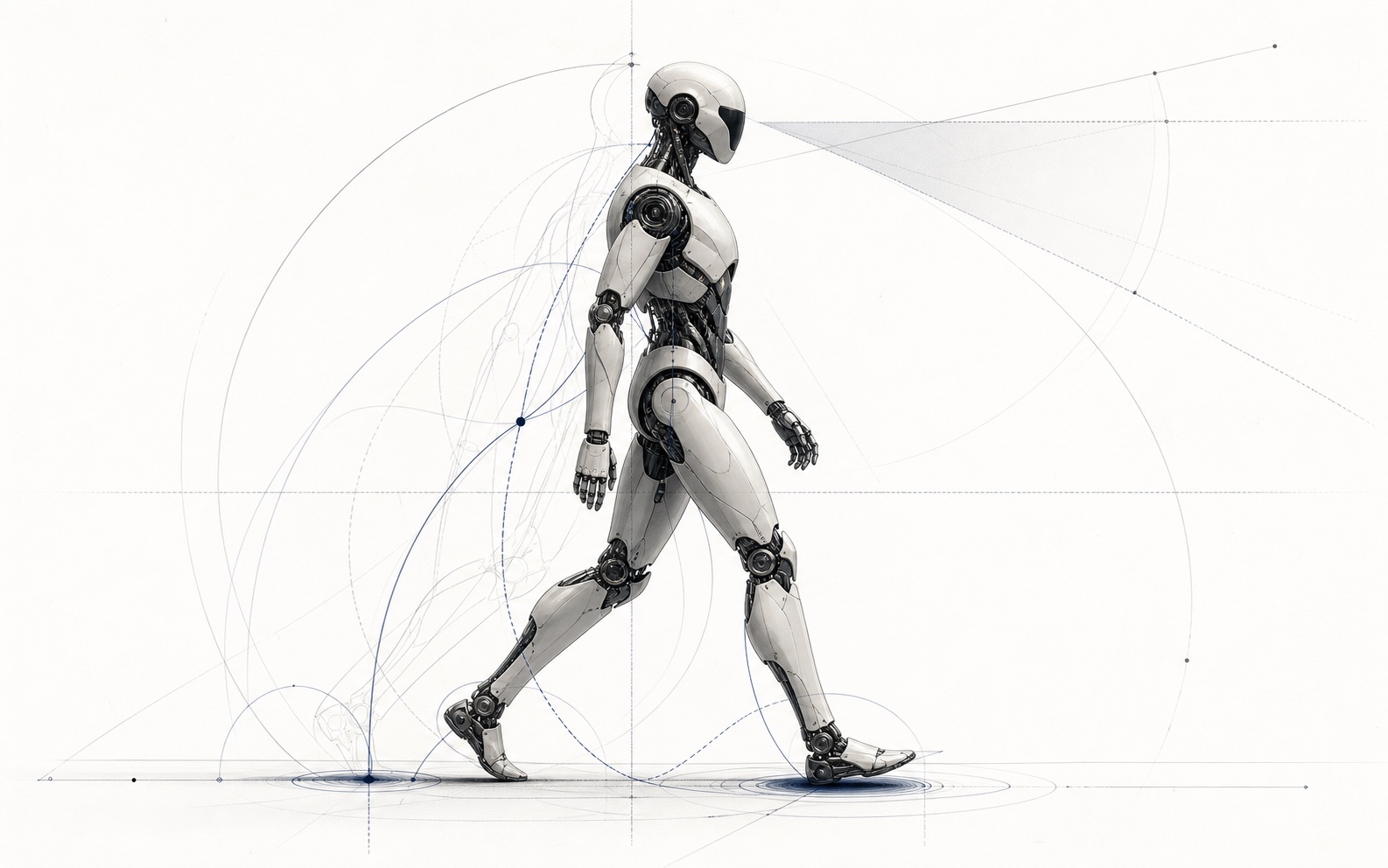
One high-level instruction never travels straight to a humanoid's motors. Movement passes through layers operating at different speeds. Separating intent, whole-body motion and local stabilization makes a demonstration or robot-sport entry easier to evaluate.
Intent selects the task
The highest layer represents what the system or operator is trying to do: walk to a point, reach, recover, punch or stop. Input can come from teleoperation, a planned sequence, a learned vision-language-action policy or a combination of them.
This layer can use rich perception and substantial compute, but it does not need to command every motor at actuator rate. Its output is usually a target, trajectory or action representation that lower layers can execute.
Whole-body control allocates movement
A humanoid action involves constraints across the entire body. A reach changes balance. A kick shifts the centre of mass and reduces the support area. Whole-body control distributes the requested motion across torso, arms and legs while respecting joint limits, contacts and kinematics.
Research systems such as OmniH2O show how human motion data can be retargeted to a humanoid and then stabilized by a learned controller. Figure describes Helix 02 as coordinating full-body behaviour from onboard sensing. These are different architectures, but both illustrate the division between an action representation and the control needed to make it physically viable.
Stabilization runs closer to the body
Fast feedback loops use joint position, velocity, inertial sensing and contact estimates to correct motion. They react to errors and disturbances before a slower planning system could recompute an entire task. Motor controllers then translate desired positions, velocities or torques into actuator commands.
Remote direction can coexist with onboard balance correction. The label “teleoperated” therefore gives an incomplete account of the control system. An operator may choose direction and timing while onboard software maintains posture and coordinates joints.
Match reporting should expose the boundary
Robot-sport reporting should identify which decisions are human, which come from a policy and which belong to stabilization. Communication delays, intervention rules and failure of the command link also belong in the technical record.
Video alone rarely answers those questions. A clean technical disclosure can: input device, control mode, onboard compute, allowed assists and the actions that require no live human command. That vocabulary makes comparisons between teams more accurate without demanding publication of proprietary code.
Public demonstrations and manufacturer descriptions establish that a behaviour occurred. General reliability, autonomy and match configuration require separate evidence.
Sources and reporting notes
- Figure: Helix 02 full-body autonomy
- Boston Dynamics: Atlas from research to industrial humanoid
- Google DeepMind: Gemini Robotics
- EngineAI: T800 product specifications
- OmniH2O: Whole-body humanoid teleoperation and learning
Frequency and capability claims are attributed to their publishers. ClankerSports has not benchmarked the systems.